
Highguard | Wildlight Entertainment
Launch readiness, scale testing, and 24/7 live operations support from Multiplayer Wizards

“Couldn’t have done it without you.”
— Sam Wolpert, Technical Director, Wildlight Entertainment
Executive Summary
Wildlight Entertainment brought in Multiplayer Wizards to help prepare Highguard for launch, live player traffic, and post-launch operations. The game pivoted during development and the Wildlight team was working to a tight deadline, leaving limited internal bandwidth for load testing, capacity planning, launch process design, and ongoing 24/7 operational support.
Multiplayer Wizards took ownership of the launch-readiness workstream, including large-scale load testing, latency-tolerance testing, observability, runbooks, alerts, deployment pipelines, release processes, server scaling, cost planning, war-room support, and post-launch incident response.
The engagement shifted Highguard from an unproven launch position to tested infrastructure, rehearsed operating procedures, and live support paths ready for launch.
| 750k+ concurrent player count load tested | 100k concurrent CCU during launch week | 5+ launch-week patches rolled to players | MULTIPLE production builds deployed per day via automated pipelines |
Game & Studio Context
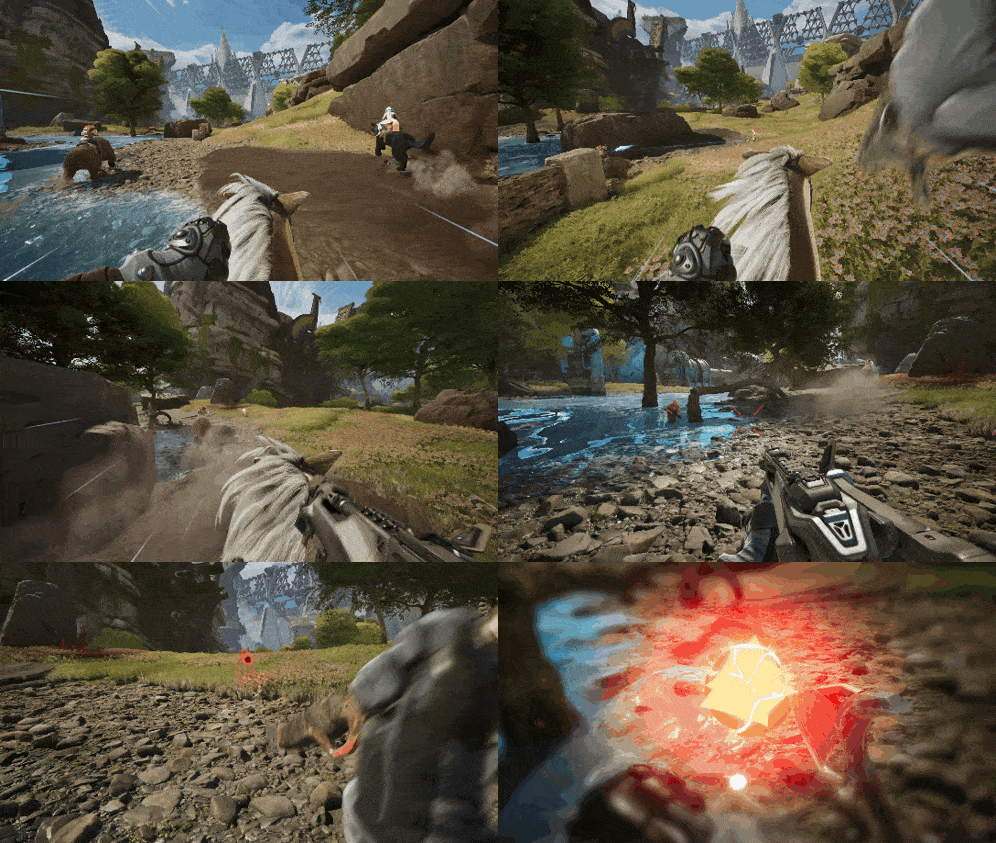
Highguard was Wildlight Entertainment’s debut online multiplayer title: a PvP raid shooter built for an ongoing, connected player experience. That made backend stability, scalability and operational readiness vital to launch. If the technology failed when players arrived, the game risked disruption at the exact moment it needed momentum.
The challenge focused around launch-readiness work requiring a host of intensive prep work that demanded attention a small engineering team couldn’t easily spare while also working to finish the game.
“Thank you for all the great stuff your team did. My biggest fear the week beforehand was the online services/back end. That actually ran really well with a big dollop of help from your team.”
— Colin Robinson, SVP Publishing and Partnerships, Wildlight Entertainment


The Challenge
Wildlight had pivoted and was working to a tight launch deadline. Their internal engineers needed to stay focused on the game, while a large body of operational prep work still needed to be completed before launch.
The core objective was simple, but technically demanding: the tech had to work on launch day and keep working indefinitely. That meant proving capacity before going live, validating infrastructure behaviour under heavy load, preparing the team for live incidents, and making sure patches could be deployed quickly without turning every release into a manual fire drill.
Early load tests had failed to pass 10,000 players, which made scale validation an early priority. Wildlight needed confidence that the infrastructure could handle real player demand, that the right telemetry and alerting would be visible during launch, and that support paths were in place for issues popping up.
Enter Multiplayer Wizards
Multiplayer Wizards supported Wildlight across three phases: pre-launch preparation, launch execution, and post-launch support. The work combined technical delivery with operational planning, giving Wildlight a dedicated multiplayer infrastructure team without pulling focus away from its own game engineers.
Delivery was structured around weekly updates, a dated roadmap, and close collaboration with Wildlight’s engineering team. Multiplayer Wizards worked across the load-testing effort, then supported launch and post-launch operations with 24/7 coverage, alerting, and escalation management.


Pre-launch: prove the infrastructure before players arrive
The pre-launch phase focused on ensuring both teams were certain the game was ready for launch. Multiplayer Wizards ran a large program of load testing, including soak tests, ramp tests, max-CCU tests, spike and stress tests, and latency-tolerance testing. This was designed to expose infrastructure limits before launch day, not while players were logging in.
To make the testing practical and cost-efficient, Multiplayer Wizards created a test game server that replicated the server binary. This allowed Wildlight to run cheaper large-scale load tests without relying on real game servers for each test cycle.
Launch: turn risk into an operating model
Launch planning then turned engineering risk into a practical operating model. Multiplayer Wizards helped prepare capacity plans, war-room processes, Day 1 patching, KPI and SLO creation, launch checklists, runbooks, alerts, and escalation paths.
This gave Wildlight a complete picture of infrastructure health right from the start; metrics, logs, and alerts were set up across the infrastructure, with Grafana dashboards and clear response paths available to the team operating through launch.


Post-launch: support live operations, patches and scale
Once the game was live, the focus shifted to coverage, incident readiness, and release cadence; the team provided 24/7 support, alert and incident response, and escalation management across the post-launch window.
The team also helped Wildlight move into a live-ops rhythm; deployment pipelines and release processes enabled multiple builds to production per day with minimal manual intervention, server scaling and A/B patching processes supported smoother updates, and Day 1 patching and follow-on releases could be managed without disrupting the team more broadly.
Results & Benefits
Working with Multiplayer Wizards gave Wildlight capacity, live observability, repeatable deployment processes, and a support model ready for launch that had all been battle-tested. The clearest proof point was scale: tests that had previously failed below 10,000 players were replaced by validation beyond 750,000 players.
Launch week saw a smooth launch, with Highguard supporting 100,000+ players in its first week, and rollouts of more than five patches in the first few days, as well as automated production deployment that helped ship multiple builds per day. Within two weeks, Wildlight also shipped a new game mode that included major infrastructure changes.
| Area | Before | After |
|---|---|---|
| Infrastructure capacity | Load tests did not pass for 10k players | Infrastructure tested beyond 750k players |
| Deployment speed | No established production release rhythm | Multiple production builds per day via automated pipeline |
| Observability | No complete game-health visibility | Full metrics, logs, dashboards and alerts |
| Infrastructure spend | Cost profile not yet optimised | Scaling and instance sizing used to keep spend controlled |
| Launch support | Small internal team with limited redundancy | 24/7 coverage, alerting, escalation and incident response |
“Invaluable. Money well spent.”
— Mike Forrest, Lead Services & Platform Engineer, Wildlight Entertainment
Why It Mattered
Technical confidence matters for a multiplayer launch, because the backend is key to the player experience. Matchmaking, scaling, deployments, monitoring, and incident response all shape whether players can get in, stay connected, and receive updates.
By taking launch readiness off Wildlight’s plate, Code Wizards helped the studio keep its core engineering attention on the game itself. Multiplayer Wizards became Wildlight’s specialist launch partner with the processes, tooling, and multiplayer infrastructure experience needed to prepare for a real market activation.
The practical results were a smoother launch and consistent post-launch cadence. Online services ran well, patching was repeatable, and operational support was ready around the clock if it was needed.
What We Learned
Helping to launch Highguard reinforced a lesson that applies to most multiplayer projects: launch readiness can’t be compressed into a final checklist right at the end. Aspects such as scale testing, observability, deployment automation, and incident response need to be designed, tested, and rehearsed long before players arrive.
| Test realistically, but cost-effectively: Large-scale validation is essential, but test design matters. The fake game server helped make repeated testing more affordable. |
| Operational visibility is launch infrastructure: Dashboards, logs, alerts, and SLOs are not optional extras when a team needs to react in real-time. |
| Release speed depends on process: Automated pipelines and patching processes turned post-launch changes into a repeatable operating rhythm. |
| Specialist support protects small teams: A lean internal engineering team can stay focused on the game while multiplayer infrastructure specialists manage launch readiness and live support. |
Subscribe to our
newsletter
"*" indicates required fields